

Global Recycled Asphalt Market Led by North America, CRH, LafargeHolcim, Eurovia Drive Sustainable Growth
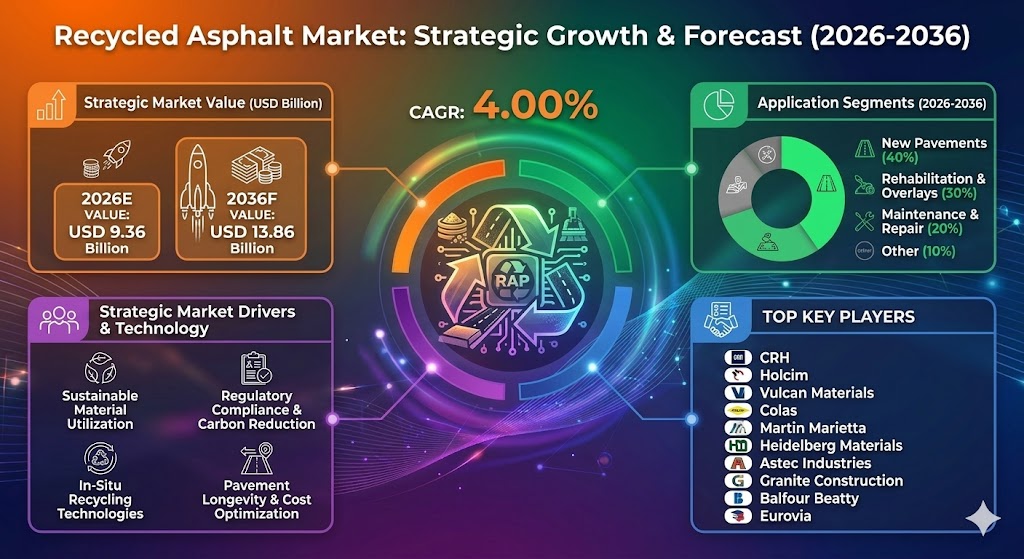
Recycled Asphalt Market grows with sustainable infrastructure demand, cost-efficient road construction, and government-backed recycling initiatives.
ROCKVILLE, MD, UNITED STATES, April 9, 2026 /EINPresswire.com/ -- The global recycled asphalt market is valued at USD 9.00 billion in 2025 and is projected to reach USD 9.36 billion in 2026, expanding to USD 13.86 billion by 2036 at a CAGR of 4.0%. The market is set to create an incremental opportunity of USD 4.50 billion over the forecast period.Transformation in the market is being driven by regulatory mandates on recycled asphalt pavement (RAP) usage, rising virgin bitumen costs, and increasing emphasis on circular construction practices. What was once considered a cost-saving alternative is now a core strategic asset for infrastructure contractors aiming to optimize margins and sustainability compliance.
Get detailed market forecasts, competitive benchmarking, and pricing trends: https://www.factmr.com/connectus/sample?flag=S&rep_id=5868
Quick Stats
Market Size (2025): USD 9.00 Billion
Market Size (2026): USD 9.36 Billion
Forecast Value (2036): USD 13.86 Billion
CAGR (2026–2036): 4.0%
Incremental Opportunity: USD 4.50 Billion
Leading Segment: Recycled Asphalt Pavement (RAP) – 62% share
Leading Region: North America (USA dominance)
Key Players: CRH, Holcim, Vulcan Materials, Colas, Martin Marietta
Executive Insight for Decision Makers
The market is undergoing a shift from optional recycling to mandated adoption. Contractors and OEMs must:
Invest in RAP processing infrastructure
Integrate rejuvenator technologies for higher recycled content
Align with government procurement standards
Failure to adapt may result in:
Loss of public infrastructure contracts
Higher raw material costs
Reduced competitiveness in sustainability-driven bids
Market Dynamics
Key Growth Drivers
Government mandates requiring 30–50% RAP content in paving projects
Rising bitumen prices, increasing demand for recycled alternatives
Expansion of infrastructure rehabilitation projects globally
Circular economy regulations across Europe and North America
Key Restraints
Quality variability in recycled materials
Technical limitations in high-performance applications
Dependency on consistent RAP supply and processing standards
Emerging Trends
Adoption of digital quality monitoring systems
Growth in rejuvenator additives for binder restoration
Integration of smart recycling plants
Increasing use of cold mix and in-place recycling technologies
Segment Analysis
Leading Segment: RAP dominates with 62% market share (2026)
Fastest-Growing Segment: Rejuvenators & binder modifiers
Breakdown
By Product: RAP, RAS, Rejuvenators
By Technology: Hot Mix (53%), Cold Recycling, Foam Bitumen
By End Use: Road Construction & Overlays (71%), Parking, Civil Works
Strategic Importance
RAP serves as the foundation of sustainable road construction, while rejuvenators enable higher recycling ratios without compromising durability.
Supply Chain Analysis
Key Components
Raw Materials: Reclaimed asphalt pavement, shingles, additives
Manufacturers: Asphalt producers, recycling plant operators
Distributors: Construction material suppliers, contractors
End-Users: Highway agencies, infrastructure developers, municipalities
Who Supplies Whom
Milling contractors supply RAP →
Asphalt plants process RAP with additives →
Contractors use recycled mix for road construction →
Governments and municipalities procure final output
This integrated chain makes RAP processing capability a competitive differentiator.
Pricing Trends
Pricing operates in a hybrid model:
Commodity-driven (RAP, aggregates)
Premium pricing (advanced additives, high-quality mixes)
Key Influencing Factors
Bitumen price volatility
RAP availability and quality
Regulatory compliance costs
Transportation and logistics
Margin Insights
Contractors achieve 10–25% cost savings using RAP
Vertically integrated players maintain higher margins through supply control
Regional Analysis
Top 5 Countries by CAGR
USA – 4.6%
Mexico – 4.4%
Germany – 4.2%
France – 4.0%
UK – 3.8%
Regional Insights
North America: Strong growth due to federal infrastructure funding
Europe: Driven by strict recycling regulations
Asia-Pacific: Emerging adoption with infrastructure expansion
Developed vs Emerging
Developed markets focus on compliance and innovation
Emerging markets emphasize cost efficiency and infrastructure scaling
Competitive Landscape
Market structure: Moderately consolidated
Top players control significant share through integrated operations
Key Companies
CRH
Holcim
Vulcan Materials
Colas
Martin Marietta
Heidelberg Materials
Astec Industries
Granite Construction
Competitive Strategies
Investment in recycling plants and RAP networks
Development of advanced processing technologies
Expansion through infrastructure contracts and partnerships
Strategic Takeaways
For Manufacturers
Expand RAP processing capacity
Invest in additive innovation
For Investors
Target companies with vertical integration and infrastructure exposure
Focus on regions with strong regulatory backing
For Marketers & Distributors
Position recycled asphalt as cost-efficient and sustainable
Build relationships with government agencies and contractors
Future Outlook
The market is expected to evolve toward:
Higher RAP incorporation rates (above 50%)
Increased use of AI-driven quality control systems
Strong alignment with net-zero construction goals
Sustainability and digitalization will redefine competitive positioning.
Conclusion
The recycled asphalt market is transitioning into a strategic cornerstone of modern infrastructure development. With regulatory mandates tightening and cost pressures rising, adoption is no longer optional but essential.
Companies that invest in technology, integration, and sustainability will unlock long-term value, while laggards risk losing relevance in an increasingly performance- and compliance-driven market.
Why This Market Matters
Recycled asphalt is not just a construction material—it is a critical enabler of sustainable infrastructure, delivering cost efficiency, environmental compliance, and long-term performance in global road networks.
Unlock 360° insights for strategic decision making and investment planning: https://www.factmr.com/checkout/5868
To View Related Report:
Titanium Dioxide Nanomaterials Market https://www.factmr.com/report/698/titanium-dioxide-nanomaterials-market
High Purity Quartz Sand Market https://www.factmr.com/report/699/high-purity-quartz-sand-market
Chemical Silage Additives Market https://www.factmr.com/report/701/chemical-silage-additives-market
Feed Sucrose Market https://www.factmr.com/report/702/feed-sucrose-market
About Fact.MR
Fact.MR is a global market research and consulting firm, trusted by Fortune 500 companies and emerging businesses for reliable insights and strategic intelligence. With a presence across the U.S., UK, India, and Dubai, we deliver data-driven research and tailored consulting solutions across 30+ industries and 1,000+ markets. Backed by deep expertise and advanced analytics, Fact.MR helps organizations uncover opportunities, reduce risks, and make informed decisions for sustainable growth.
S. N. Jha
Fact.MR
+ +1 628-251-1583
sales@factmr.com
Legal Disclaimer:
EIN Presswire provides this news content "as is" without warranty of any kind. We do not accept any responsibility or liability for the accuracy, content, images, videos, licenses, completeness, legality, or reliability of the information contained in this article. If you have any complaints or copyright issues related to this article, kindly contact the author above.
